


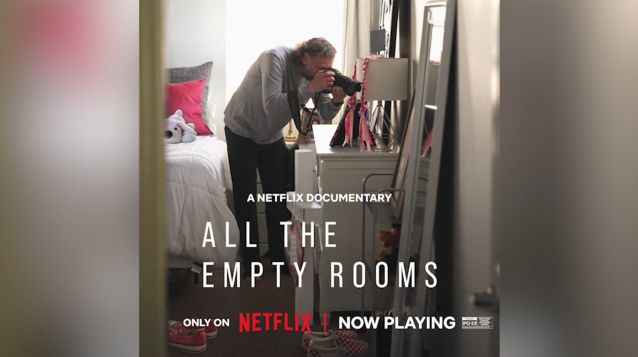
Silence as a Sanctuary: A Review of the Oscar-Winning “All the Empty Rooms”
In the landscape of modern documentary filmmaking, the loudest messages often come from the quietest spaces. All the Empty Rooms (2025), directed by Joshua Seftel and produced in collaboration with Netflix and Hyperobject Industries, is a haunting, 33-minute meditation on the physical and emotional void left behind by school shootings in the United States. Eschewing the typical frantic news cycle of sirens and political punditry, the film instead opts for a “visual pilgrimage” into the bedrooms of children who never came home.
Fresh off its win for Best Documentary Short at the 98th Academy Awards in March 2026, the film has transitioned from a niche festival darling to a global conversation starter. It is a work that demands the viewer’s presence, turning the mundane—a hair tie on a doorknob, an unwashed laundry basket, an overdue library book—into sacred relics of lives interrupted.
Film Overview and Technical Data
| Feature | Details |
| Title | All the Empty Rooms |
| Release Date | December 1, 2025 (Netflix) |
| Director | Joshua Seftel |
| Cast / Participants | Steve Hartman, Lou Bopp, Gloria Cazares, Frank Blackwell |
| Genre | Documentary Short |
| Runtime | 33 Minutes |
| Major Awards | Best Documentary Short (98th Academy Awards, 2026) |
| Production Companies | Smartypants, Artemis Rising, Hyperobject Industries |
Full Plot Synopsis: The Architecture of Absence
The narrative of All the Empty Rooms is framed by a seven-year journey undertaken by veteran CBS News correspondent Steve Hartman and photographer Lou Bopp. Hartman, known primarily for his “On the Road” human-interest segments, pivots here toward a much darker, more permanent reality. The film chronicles their efforts to memorialize the untouched bedrooms of children lost to gun violence.
The documentary focuses on four specific children and their families:
-
Hallie Scruggs: A victim of the 2023 Nashville Covenant School shooting.
-
Dominic Blackwell: A 14-year-old lost in the 2019 Saugus High School shooting.
-
Gracie Anne Muehlberger: A 15-year-old also lost in the Saugus shooting.
-
Jacklyn “Jackie” Jaylen Cazares: A 9-year-old victim of the 2022 Uvalde massacre.
The “plot” is not a linear story of an event, but a series of visitations. We follow Hartman and Bopp as they enter these “frozen” rooms. In Nashville, they witness Hallie’s books and art; in Santa Clarita, they see the letters Gracie wrote to her future self. In Uvalde, Gloria Cazares shows the “About Me” chalkboard where Jackie had written her dream of becoming a veterinarian.
The film culminates in the realization of a photobook created by Bopp, which serves as a physical bridge between the families and a world that too often looks away. The final act moves from the private silence of the bedrooms to the public stage, reflecting on how these families use these preserved spaces as an axis around which their grief—and their love—revolves.
Detailed Critique: Analysis of a Masterpiece
1. Direction and Perspective
Director Joshua Seftel (previously Oscar-nominated for Stranger at the Gate) exercises immense restraint. In a genre where “misery porn” is a constant risk, Seftel maintains a respectful distance. He allows the camera to linger on objects rather than forcing emotional reactions from the parents. By positioning Steve Hartman not as a reporter, but as a “tour guide” through grief, the film achieves a tone of gentle curiosity rather than aggressive journalism.
2. Visuals and Cinematography
Cinematographer Matt Porwoll utilizes natural light to emphasize the “lived-in” quality of the rooms. The visual language relies heavily on the “macro”: close-ups of dust on a shelf, the texture of a favorite blanket, or the specific way a pair of shoes was kicked off. These images, combined with Lou Bopp’s still photography, create a layering of time—the past (the life lived) and the present (the absence) occupying the same frame.
3. Sound and Score
The original score by Alex Somers is ethereal and minimalist. It functions less like music and more like a resonant hum, filling the “empty” spaces of the rooms without overwhelming the dialogue. The sound design by Peter Albrechtsen highlights the ambient noises—the creak of a floorboard, the rustle of a curtain—which amplifies the heavy silence that the film seeks to document.
4. Thematic Depth
The central theme is the sedimentation of memory. The film argues that these rooms are not just gravesites, but living extensions of the children. As Gracie’s father notes, “As long as that room exists, she exists in a way.” It also touches on the privilege of moving on, noting how the American public desensitizes itself to tragedy while these families remain anchored in the moment the clock stopped.
Strengths and Weaknesses
Strengths:
-
Intimate Specificity: By focusing on the small details of four lives, the film makes the staggering statistics of gun violence feel personal and undeniable.
-
Non-Political Approach: While the subject is inherently political, the film avoids partisan rhetoric, making its human message accessible to a wider audience.
-
Restrained Editing: The 33-minute runtime is lean; every shot feels purposeful and earned.
Weaknesses:
-
Self-Reflexive Reporting: Some critics have noted that the film occasionally spends too much time on “reporting the reporting”—focusing on Hartman and Bopp’s process—which can briefly distract from the families.
-
Emotional Intensity: The film is profoundly draining; its effectiveness is also its greatest barrier to casual viewership.
Final Verdict: A Necessary Witness
All the Empty Rooms is a devastating, essential piece of cinema. It does not offer easy answers or legislative roadmaps; instead, it offers the one thing modern society often lacks: sustained attention. It forces the viewer to stand in the void and acknowledge that every statistic was a child who liked SpongeBob, dreamed of being a vet, or left their toothpaste cap off. It is a masterpiece of empathy that justifies its Oscar win through pure, unadorned honesty.
Final Rating: 4.5 / 5 Stars