


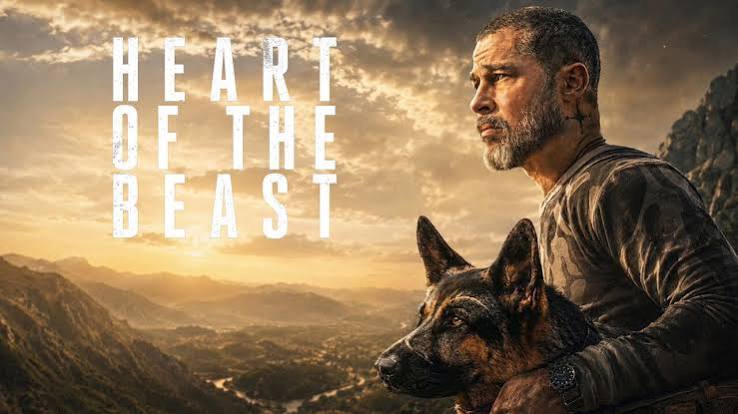
Heart of the Beast (2026) Movie: Brad Pitt and Odin Face the Ultimate Fight for Survival
Heart of the Beast (2026) is a survival adventure thriller directed by David Ayer and starring Brad Pitt as James Belmont, a former Army Special Forces soldier whose retreat into the wilderness becomes a desperate battle to stay alive. Alongside him is Odin, his retired military working dog and the emotional center of a story built around trauma, loyalty, endurance, and companionship.
Written by Cameron Alexander, the film reunites Pitt with Ayer more than a decade after their collaboration on Fury. Rather than building its identity around large-scale combat, however, Heart of the Beast strips the action down to its essentials: one damaged man, one extraordinarily loyal dog, and an unforgiving landscape.
Released theatrically in the United States on September 25, 2026, the 101-minute film combines survival-thriller tension with an unusually intimate human-animal relationship. J.K. Simmons and Anna Lambe also appear in the cast, while cinematographer Mauro Fiore gives the wilderness an imposing visual presence.
Heart of the Beast (2026) Movie Details
| Detail | Information |
|---|---|
| Movie | Heart of the Beast |
| Release Year | 2026 |
| U.S. Release Date | September 25, 2026 |
| Director | David Ayer |
| Screenwriter | Cameron Alexander |
| Lead Star | Brad Pitt |
| Supporting Cast | J.K. Simmons, Anna Lambe |
| Character | James Belmont |
| Genre | Adventure, Thriller, Action, Drama |
| Runtime | 101 minutes |
| Rating | PG-13 |
| Cinematography | Mauro Fiore |
| Editor | Dody Dorn |
| Distributor | Paramount Pictures |
| Language | English |
What Is Heart of the Beast About?
Heart of the Beast follows James Belmont, a former Army Special Forces soldier carrying the psychological scars of his military past. His closest companion is Odin, a retired combat dog who has endured his own physical and emotional consequences of service.
Belmont has largely withdrawn from ordinary life. Seeking isolation, he takes Odin into the remote Alaskan wilderness aboard a small aircraft. The trip initially provides exactly what James appears to want: distance from civilization, silence and an opportunity to exist somewhere beyond the memories that continue to haunt him.
That isolation quickly becomes dangerous.
After James suffers a medical emergency while flying, the aircraft crashes, leaving the pair stranded far from civilization. What began as an escape becomes a survival mission.
Heart of the Beast Full Plot Synopsis
Following the crash, James must assess his injuries, limited resources and almost impossible surroundings. Odin remains beside him, functioning not simply as a pet but as the trained military partner he has always been.
Their route back to civilization forces them across dangerous terrain where weather, exhaustion, wildlife and James’ declining physical condition constantly threaten their progress. Wolves and other predators add conventional survival-thriller danger, but the film is equally interested in the psychological battle taking place inside James.
Memories of combat repeatedly intrude upon the present.
Ayer uses James’ journey through the wilderness as an extension of the character’s internal struggle. Surviving therefore means more than finding food, shelter or a route home. James must continue moving despite the trauma that has made withdrawal from the world seem easier than confronting it.
Odin becomes essential to that process.
The dog’s presence gives James something beyond himself to protect, while their shared military history creates a relationship that requires very little dialogue to explain. Odin also carries visible reminders of his own service, making the pair feel less like owner and animal than two veterans attempting to navigate life after war.
Their journey increasingly tests the limits of both.
The wilderness alternates between extraordinary beauty and immediate danger. Vast mountains, forests and waterways emphasize just how insignificant two individual survivors can appear against nature. When the film shifts closer to James and Odin, however, that scale disappears and the story becomes intensely personal.
The central question gradually changes from whether James can defeat the wilderness to whether the connection between him and Odin can give both of them enough reason to keep going.
That relationship ultimately drives the film toward its emotional conclusion, transforming what could have been a conventional wilderness adventure into a story about companionship, survival and the difficulty of returning from traumatic experiences.
Brad Pitt Gives the Movie Its Human Weight
Brad Pitt’s performance as James Belmont is deliberately restrained. The character does not communicate his past through long speeches or constant exposition. Much of the performance depends on physical behavior, silence and Pitt’s reactions to Odin.
It is an effective choice for a movie in which the protagonist spends significant stretches without another human being to talk to.
Pitt also avoids making Belmont an invincible action hero. His military experience gives him practical survival abilities, but his body has limitations and his psychological wounds remain present. That vulnerability is crucial because it prevents the wilderness sequences from becoming a simple demonstration of competence.
The result is a performance built around endurance rather than dominance.
Odin Is the Emotional Heart of the Film
Despite Pitt’s star presence, Odin is arguably the defining character of Heart of the Beast.
The filmmakers treat the dog as an active participant rather than an accessory designed merely to generate sympathy. Odin observes James, reacts to danger, protects him and communicates through movement and expression.
Four dogs were used to portray Odin, with a German Shepherd named Uber serving as the primary performer.
The editing is especially important in establishing the relationship. Cuts between James and Odin create the impression of conversations that do not require words. A look, movement or hesitation can carry as much emotional information as dialogue.
This approach makes their bond believable before the screenplay asks audiences to become emotionally invested in their survival.
David Ayer Takes a More Intimate Approach
David Ayer is closely associated with stories involving soldiers, police officers, violence and tightly bonded groups. Heart of the Beast retains some of those interests but reduces the traditional unit to its smallest possible form.
Here, the team consists of one man and one dog.
That simplicity works in the film’s favor. Ayer can concentrate on the mechanics of survival while exploring loyalty without constantly interrupting the journey with additional characters or subplots.
The director also understands that tension does not always require action. Some of the movie’s strongest sequences come from waiting, watching and listening as James attempts to determine what might be approaching through the wilderness.
The quieter passages allow the landscape and the relationship between James and Odin to carry the film.
Cinematography Turns the Wilderness Into a Character
Mauro Fiore’s cinematography is one of the film’s most distinctive technical elements.
Although the story takes place in Alaska, significant wilderness material was filmed in remote areas of New Zealand’s South Island. Some filming locations were accessible only by helicopter.
Fiore frequently emphasizes enormous natural spaces surrounding James and Odin. Mountains, lakes and dense wilderness appear beautiful from a distance while becoming threatening once the characters must physically cross them.
Wide compositions establish vulnerability; tighter camerawork during moments of danger creates the opposite effect, compressing the environment around James.
The contrast reinforces one of the film’s central ideas: nature can simultaneously represent freedom and terrifying isolation.
Trauma, Loyalty and Survival
Beneath its straightforward survival premise, Heart of the Beast is fundamentally interested in postwar trauma.
James may have physically left military service, but the experience has not entirely left him. His retreat into the wilderness initially appears peaceful, yet isolation also allows him to avoid parts of civilian existence.
Odin complicates that isolation because the dog represents both James’ military past and his strongest remaining emotional connection.
This creates an interesting contradiction.
The companion associated with painful memories is also the companion helping him survive them.
Rather than presenting recovery as a sudden transformation, the film frames survival itself as a series of choices: keep walking, protect your companion, respond to danger and continue despite exhaustion.
Screenplay and Pacing
Cameron Alexander’s screenplay relies on a familiar survival-film structure. A journey begins, catastrophe removes the characters from safety, and increasingly difficult obstacles stand between them and civilization.
That familiarity is both useful and limiting.
The simple structure keeps the film accessible and allows its emotional relationship to remain central. At 101 minutes, the movie rarely becomes overloaded with unnecessary narrative machinery.
At the same time, experienced viewers will recognize several genre conventions, including hostile wildlife, worsening physical conditions and escalating obstacles.
The film is therefore strongest when it concentrates less on what James must survive next and more on why he continues trying.
Sound and Music Strengthen the Isolation
Sound plays an unusually important role because large portions of Heart of the Beast contain limited conversation.
Wind, water, footsteps, animal noises and the movement of the forest become part of the suspense. Silence itself frequently functions as a warning.
The musical score complements that atmosphere without constantly overwhelming the wilderness. The combination allows the film to move between intimate drama and larger adventure sequences while maintaining a consistent sense of isolation.
Heart of the Beast Strengths and Weaknesses
Strengths
The movie’s greatest strength is the convincing relationship between James and Odin. Pitt’s restrained performance allows the canine character to become a genuine dramatic partner rather than a narrative device.
Mauro Fiore’s expansive cinematography gives the survival story cinematic scale, while Ayer’s direction is particularly effective during quieter scenes built around exhaustion, uncertainty and companionship.
The concise runtime also helps maintain momentum.
Weaknesses
The underlying survival narrative follows a recognizable formula, and some encounters with wilderness threats feel more conventional than the character-driven material surrounding them.
The film occasionally pushes its emotional intentions more explicitly than necessary, particularly when the bond between James and Odin is already strong enough to communicate the same ideas visually.
Its most effective moments are generally those in which Ayer trusts Pitt, Odin and the landscape rather than emphasizing the sentiment.
Is Heart of the Beast Based on a True Story?
No. Heart of the Beast is not presented as a true story. Cameron Alexander’s screenplay is a fictional survival narrative.
Its military background, survival details and depiction of the relationship between a veteran and a working dog nevertheless give the story a recognizable real-world foundation.
Where Was Heart of the Beast Filmed?
Although the movie is set in the Alaskan wilderness, production primarily used locations in New Zealand, including remote areas of the South Island.
The locations provide the mountains, forests and expansive landscapes necessary to create the film’s sense of extreme isolation.
Heart of the Beast Review: Final Verdict
Heart of the Beast succeeds because its simplest element is also its strongest: the relationship between James Belmont and Odin.
David Ayer delivers the expected wilderness dangers—injury, extreme conditions, predators and physical exhaustion—but the film becomes more compelling when survival stops being its only concern. James and Odin are portrayed as two veterans shaped by experiences they cannot simply leave behind, and their dependence on each other gives the adventure its emotional purpose.
Brad Pitt responds with an appropriately stripped-down performance, while the canine performers give Odin enough personality and presence to function as a true co-lead. Mauro Fiore’s imposing cinematography further elevates the material by making the wilderness feel beautiful, enormous and indifferent.
The screenplay does not completely escape familiar survival-movie conventions, and occasional moments of overt sentiment can be less effective than the film’s quieter observations. Yet its sincerity and technical craftsmanship give the familiar structure considerable emotional force.
For audiences searching for a Brad Pitt survival movie, an emotional dog film, or a wilderness adventure thriller, Heart of the Beast offers all three within a compact and visually impressive story about loyalty under extreme pressure.
Ultimately, the beast in the title is not simply something waiting in the wilderness. The film is concerned with the fear, grief and survival instinct carried within its characters—and with the bond that gives them a reason to keep moving.
Heart of the Beast (2026) FAQ
When was Heart of the Beast released?
Heart of the Beast opened theatrically in the United States on September 25, 2026, with some international territories receiving the film earlier that week.
Who plays James Belmont?
Brad Pitt stars as James Belmont, a former Army Special Forces soldier stranded in the wilderness.
Who directed Heart of the Beast?
The movie was directed by David Ayer, marking another collaboration between Ayer and Pitt after Fury.
Who plays the dog Odin?
Odin was portrayed using multiple trained dogs, with Uber serving as the principal canine performer.
How long is Heart of the Beast?
The movie has a 101-minute runtime, or approximately one hour and 41 minutes.
What is Heart of the Beast rated?
The film carries a PG-13 rating in the United States for material including violence, peril, bloody/injury images and some language.
Is Heart of the Beast a true story?
No. The movie is a fictional survival story written by Cameron Alexander.
What genre is Heart of the Beast?
Heart of the Beast combines adventure, action, drama and survival-thriller elements.
SEO Title
Heart of the Beast (2026) Movie Review, Plot, Cast, Ending & Brad Pitt Survival Thriller
Meta Description
Heart of the Beast (2026) stars Brad Pitt as a Special Forces veteran stranded in the Alaskan wilderness with his combat dog Odin. Explore the plot, cast, review, themes, runtime and movie details.
Suggested URL Slug
heart-of-the-beast-2026-movie-review-plot-cast
Focus Keywords
Heart of the Beast 2026, Heart of the Beast movie, Heart of the Beast Brad Pitt, Heart of the Beast review, Heart of the Beast plot, Heart of the Beast cast, Heart of the Beast movie review, Brad Pitt 2026 movie, Heart of the Beast Odin, David Ayer Heart of the Beast
Review Schema (JSON-LD)
{
  "@context": "https://schema.org",
  "@type": "Review",
  "name": "Heart of the Beast (2026) Movie Review",
  "itemReviewed": {
    "@type": "Movie",
    "name": "Heart of the Beast",
    "dateCreated": "2026",
    "datePublished": "2026-09-25",
    "duration": "PT1H41M",
    "contentRating": "PG-13",
    "genre": [
      "Adventure",
      "Thriller",
      "Action",
      "Drama"
    ],
    "inLanguage": "en",
    "director": {
      "@type": "Person",
      "name": "David Ayer"
    },
    "actor": [
      {
        "@type": "Person",
        "name": "Brad Pitt"
      },
      {
        "@type": "Person",
        "name": "J.K. Simmons"
      },
      {
        "@type": "Person",
        "name": "Anna Lambe"
      }
    ]
  },
  "author": {
    "@type": "Organization",
    "name": "Editorial Team"
  },
  "reviewBody": "Heart of the Beast is an intimate survival adventure anchored by Brad Pitt's restrained performance and the convincing bond between Special Forces veteran James Belmont and his retired combat dog Odin. David Ayer combines wilderness tension, striking cinematography and themes of trauma, loyalty and endurance in a compact character-driven thriller."
}