


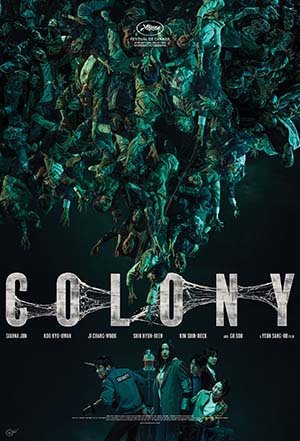
Masterclass of Dread: Yeon Sang-ho Reinvents the Zombie Genre in ‘Colony’ (2026)
Ten years after rewriting the global rules of the undead subgenre with Train to Busan (2016), director Yeon Sang-ho returns to the landscape of apocalyptic dread with Colony (2026). Premiering in the Midnight Screenings section at the 79th Cannes Film Festival before its worldwide theatrical rollout, this high-octane South Korean action-horror film marks a shift from simple survival narratives toward intricate, bio-technological claustrophobia. Co-written by Yeon and his Hellbound collaborator Choi Gyu-seok, Colony trades expansive locomotive tracks for a locked-down corporate facility, delivering a chilling study of institutional corruption, human fragmentation, and evolutionary terror.
‘Colony’ (2026): Key Film Data
| Metric / Attribute | Film Details |
| Title | Colony (Korean: 군체 / Gunche) |
| Release Date | May 15, 2026 (Cannes), May 21, 2026 (South Korea), June 3, 2026 (Indonesia) |
| Genre | Action Horror, Science Fiction, Biological Thriller |
| Director | Yeon Sang-ho |
| Screenwriters | Yeon Sang-ho, Choi Gyu-seok |
| Running Time | 122 minutes (2 hours 2 minutes) |
| Production Companies | Showbox, Wowpoint, Smilegate, Midnight Studio |
| Lead Cast | Jun Ji-hyun, Koo Kyo-hwan, Ji Chang-wook, Kim Shin-rok, Shin Hyun-been, Go Soo |
Detailed Plot Synopsis
The narrative unfolds within a sleek, multi-tiered corporate headquarters and commercial shopping complex where an elite biotechnology firm is hosting a high-stakes product presentation.
Kwon Se-jeong (Jun Ji-hyun), an ostracized and currently unemployed biotechnology professor, arrives at the event in desperate pursuit of a career lifeline. Her entry is facilitated by her ex-husband, Han Gyu-sung (Go Soo), who is quietly finalizing arrangements to emigrate overseas. The presentation quickly turns chaotic when an uncontained biological agent spreads through the facility. The pathogen does not merely reanimate the dead; it triggers a rapid, hive-minded mutation known as “Gunche.”
As the corporate defense systems institute a ruthless, automated lockdown, Se-jeong and Gyu-sung find themselves trapped in the building’s expansive subterranean shopping mall alongside an eclectic group of civilians. Among them are security specialist Choi Hyun-seok (Ji Chang-wook), his fiercely protective sister Choi Hyun-hee (Kim Shin-rok), a corporate insider named Bong-seok, and So-eun, a vulnerable student fleeing school bullies.
The early escape attempts turn tragic when Gyu-sung sacrifices his life to shield a delinquent student from the initial wave of aggression. Rather than descending into aimless bloodlust, the infected demonstrate a terrifying trait: they possess a highly integrated swarm intelligence. Se-jeong discovers that the hosts share sensory data in real time through an invasive, rapidly growing fungal mycelium network. With every failed attack, the collective consciousness learns, adapts, and restructures its strategy.
When Bong-seok reveals that rogue researcher Seo Young-chul (Koo Kyo-hwan) orchestrated the catastrophic outbreak from his laboratory on the third floor—and holds the only viable prototype vaccine—the survivors must fight upward through a vertical gauntlet of evolving biological threats and collapsing human alliances.
In-Depth Critical Analysis
Themes: The Terrors of the Collective
Colony moves away from the traditional individualistic zombie archetype in favor of a macroscopic nightmare. By naming the infection Gunche (meaning colony or swarm), Yeon and Choi craft an explicit metaphor for extreme social conformity and institutional control. The horror stems not from a loss of civilization, but from an overwhelming, predatory expansion of it. The mycelium network acts as a dark reflection of modern hyper-connectivity, where individual thoughts are subsumed by a relentless, singular agenda.
Direction and Screenplay
Yeon Sang-ho’s direction balances the visceral rhythm of an action-survival picture with the thematic weight of a corporate thriller. Working alongside co-writer Choi Gyu-seok, Yeon optimizes the script’s pacing by using the architectural layout of the locked-down facility as a narrative ladder. Each floor presents a distinct tactical challenge and a new stage of viral evolution. The screenplay avoids excessive exposition, choosing instead to reveal the mechanics of the outbreak through active observation and high-stakes deduction.
Performances and Character Dynamics
The film’s casting choices anchor the speculative science fiction elements in genuine human drama.
-
Jun Ji-hyun anchors the film as Kwon Se-jeong, delivering a calculated, cerebral performance that marks a major departure from her iconic romantic-comedy and period roles. She portrays Se-jeong with a clinical composure that gradually cracks under pressure, blending intellectual authority with the raw exhaustion of a survivor.
-
Ji Chang-wook excels as Choi Hyun-seok, grounding the film’s physical action. He subverts the traditional action-hero archetype by prioritizing defensive containment and tactical caution over reckless bravado.
-
Koo Kyo-hwan presents a chillingly erratic antagonist in Seo Young-chul. He avoids simple villain tropes, instead playing the character with a volatile, philosophical detachedness that makes his actions feel unpredictable.
-
Kim Shin-rok brings exceptional emotional gravity to her role as Hyun-hee, highlighting the film’s underlying focus on familial loyalty under existential pressure.
+-----------------------------------------------------------------+
|               Evolutionary Shift in 'Colony' (2026)             |
+-----------------------------------------------------------------+
|  Traditional Zombie Cinema      |  Yeon Sang-ho's 'Gunche'      |
|  - Scattered, erratic hordes    |  - Unified hive intelligence  |
|  - Driven by primal hunger      |  - Tactical learning ability  |
|  - Decomposing flesh            |  - Mycelium-linked synthesis  |
+-----------------------------------------------------------------+
Visuals, Production Design, and Soundscapes
The production design by Jeon Young turns the corporate complex from a symbol of modern prestige into a vertical prison. The crisp, white walls and minimalist glass architecture of the early scenes gradually give way to organic, vein-like structures as the mycelium network spreads through the building’s infrastructure.
The cinematography captures the overwhelming claustrophobia of the interior spaces, using sharp angles and deep shadows to emphasize that danger can emerge from any air duct or elevator shaft. The auditory design, crafted by Julien Paschal, replaces standard orchestral horror cues with an oppressive mix of mechanical alarms, metallic echo chambers, and the subtle, synchronized clicking of the swarm communicating through the dark.
Strengths and Weaknesses
Strengths
-
Innovative Mythology: Reconceptualizing the infected as a learning, evolving mycelium network breathes new life into a crowded genre.
-
Ensemble Acting: The creative contrast between blockbuster stars like Jun Ji-hyun and versatile character actors like Koo Kyo-hwan generates exceptional dramatic tension.
-
Pacing and Atmosphere: The script maintains an intense level of suspense, transforming the 122-minute runtime into a lean, relentless ascent.
-
Stellar Technical Execution: The seamless blending of practical visual effects with physical set design enhances the immediate, tangible reality of the threat.
Weaknesses
-
Secondary Character Development: Due to the fast-paced nature of the narrative, a few supporting figures among the civilian survivors function primarily as narrative collateral rather than fully realized individuals.
-
Familiar Structural Beats: While the biological mechanics are highly inventive, the broader trajectory of navigating a locked-down building follows established survival-horror blueprints.
Final Verdict
Colony is a triumph of contemporary South Korean genre cinema. Yeon Sang-ho successfully strips away the sprawling, macro-level debris of standard post-apocalyptic fiction to deliver a focused, claustrophobic masterclass in tension. Powered by Jun Ji-hyun’s sharp, commanding return to the big screen and a terrifyingly logical new monster, the film proves that there is still rich thematic territory to be mined within the boundaries of survival horror. It stands as an intelligent, fast-paced, and deeply unsettling exploration of what happens when human evolution takes a monstrous turn toward the collective.