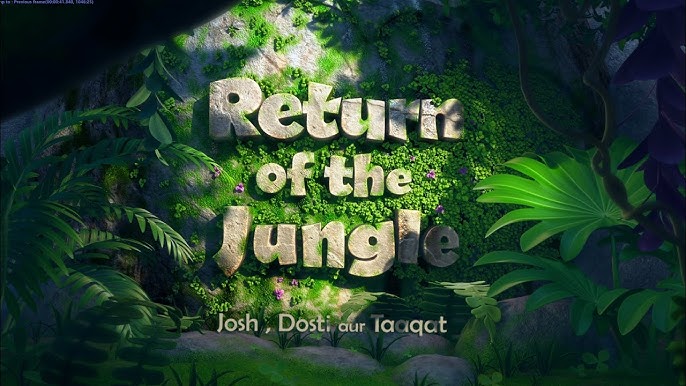
Return of the Jungle Review: A Landmark Triumph for Indian Animation
The landscape of Indian feature-length animation undergoes a tectonic shift with Return of the Jungle (2026). Directed by veteran animator Vaibhav Kumaresh and produced by the independent powerhouse Vaibhav Studios, this beautifully crafted feature challenges the long-standing industry paradigm that animation in India is purely secondary market counter-programming. Free from the constraints of re-telling standard mythological epics, Return of the Jungle delivers a contemporary, deeply nostalgic, and resonant domestic narrative. It treats its young characters and its audience with immense emotional intelligence.
Spanning a lean but incredibly efficient 96-minute runtime, the film operates simultaneously as a slice-of-life schoolyard comedy, a high-stakes adventure, and a poignant multi-generational drama. By combining distinct, hyper-local Indian design sensibilities with world-class character movement and technical precision, Kumaresh offers an inspiring template for indigenous theatrical storytelling.
Technical Overview and Production Details
| Metadata Metric | Production Specification |
| Title | Return of the Jungle |
| Release Date | May 29, 2026 (Theatrical) |
| Director / Writer | Vaibhav Kumaresh |
| Co-Screenwriter | Prosenjit Ganguly |
| Production Studio | Vaibhav Studios, Mumbai |
| Run Time | 1 Hour 36 Minutes (96 Minutes) |
| Language | Hindi |
| Genre | Animation, Adventure, Comedy, Family Drama |
| Key Voice Cast | Arav Bhatia, Rahul Malhotra, Jade Mascarenhas, Izaan Mirza, Sairaj Naik |
| Music & Background Score | Roto Shah, Advait Nemlekar, Narayan Parasuram |
Full Plot Synopsis
The narrative center of Return of the Jungle belongs to Mihir (voiced by Arav Bhatia), a wide-eyed, sensitive nine-year-old fourth grader navigating the intimidating social ecosystem of his junior school. Mihir and his close-knit circle of eccentric classmates find their daily lives dominated by fear due to Rahul Malhotra, an exceptionally menacing, towering school bully who rules the playground with institutional authority.
When a series of interactions with Rahul leaves the children feeling utterly powerless, the narrative introduces its vital emotional anchor: Thatha, Mihir’s fiercely imaginative, charismatic grandfather. Far from a passive elder archetype, Thatha is an energetic storyteller who recognizes that his grandson’s fears cannot be resolved with simple platitudes. Instead, he opens up a rich inner world, transporting the children through highly stylized, ancient tales of the Indian jungles. These historical parables are filled with fierce creatures, complex wildlife dynamics, and environmental battles that mirror the emotional micro-crises of the classroom.
Through these historical analogies, Thatha challenges Mihir and his friends to stop running from their problems and instead alter their strategic approach. The narrative beautifully transitions between the mundane reality of the schoolyard and the vivid landscapes of the subcontinental wilderness. Energized by these stories, the children hatch a plan to outsmart Rahul by building a giant, intimidating mechanical dinosaur for an upcoming school event, culminating in a tense, nerve-wracking game of playground cricket that tests their resolve.
When the conflict expands beyond the school walls and leads to a transformative journey across the arid terrains of Rajasthan, the children discover that real courage is not found in physical dominance. Instead, true strength lies in absolute determination, radical empathy, and understanding the root of an adversary’s anger.
Detailed Film Critique
Themes and Narrative Depth
At its core, Return of the Jungle deals with the psychological mechanisms of bullying and the restorative power of oral traditions. The screenplay, co-written by Kumaresh and Prosenjit Ganguly, wisely avoids treating schoolyard politics as trivial child’s play. To a nine-year-old, the domain of a bully feels as absolute as an apex predator’s territory.
By juxtaposing these childhood anxieties with the primal rules of the ancient wilderness, the filmmakers elevate a simple coming-of-age story into an exploration of human behavior. The film’s ultimate lesson leans away from simple retaliation, favoring the far more difficult paths of compassion and conflict resolution. It demonstrates a level of thematic maturity rarely seen in contemporary family cinema.
Direction and Screenplay Structure
Vaibhav Kumaresh’s direction is incredibly precise, balancing humor and heart without ever letting the pacing drag. The transition points between the grounded urban environments of modern India and the lush, expressionistic historical jungle sequences are handled with masterful fluidity.
The script balances its ensemble cast brilliantly, ensuring that each member of Mihir’s friend group possesses distinct personality traits, flaws, and micro-arcs. More importantly, the antagonist, Rahul, is given subtle behavioral nuances that prevent him from becoming a flat, caricature villain.
Animation Technique and Visual Design
Visually, the film is an absolute revelation for Indian cinema. Eschewing the derivative, sterile aesthetics of low-budget overseas outsourcing houses, Vaibhav Studios relies heavily on stylized, organic character designs that feel deeply rooted in Indian illustration traditions.
The lighting design deserves special praise. It accurately captures the specific, hazy gold of late afternoon Indian summer sun on concrete playgrounds, which contrasts beautifully with the deep emeralds and rich earths of the ancient jungle sequences. The character animation is fluid and expressive, relying heavily on subtle facial micro-expressions and body language to convey deep emotional weight without over-relying on dialogue.
Visual Style Analysis:
[Schoolyard Reality]   --> Hazy, sun-bleached ochres, concrete textures, realistic geometry
[Jungle Parables]      --> Hyper-saturated emeralds, deep shadows, mythic scale and fluidity
Sound Design and Musical Integration
The sonic landscape of Return of the Jungle matches the exceptional quality of its visuals. The acoustic environment designed by Karan Arjun Singh and Deep Bawa feels incredibly authentic, capturing the chaotic, overlapping noise of school corridors and the textured, ambient insect chirps of the wilderness.
The collaborative score by Roto Shah, Advait Nemlekar, and Narayan Parasuram avoids generic, overly synthetic orchestral swells. Instead, it utilizes traditional Indian percussion and acoustic instruments in a modern, rhythmic arrangement that drives the adventure forward while effortlessly underscoring the film’s quieter, emotional beats.
Comprehensive Strengths & Weaknesses
Strengths
-
Original Intellectual Property: Breaks entirely free from the cyclical adaptations of folklore and mythology, proving that original Indian animation can stand on its own feet.
-
Deeply Resonant Visual Language: The art direction displays a gorgeous, authentic cultural aesthetic that values local texture over generic western or eastern animation clones.
-
Nuanced Character Development: Character relationships feel organic, messy, and intensely real, which helps ground the broader adventure elements.
-
Exceptional Voice Performance Direction: Voice directors Eliza Lewis, Greta Lewis, and Ramendra Vasishth elicit natural, grounded performances from the child voice actors, avoiding the stiff, high-pitched delivery that plagues lesser local productions.
Weaknesses
-
Pacing Shifts in the Third Act: The sudden geographic shift to Rajasthan in the latter portion of the film expands the narrative scale, but occasionally threatens to disrupt the tight, claustrophobic tension established in the schoolyard.
-
Nostalgia Bias: Certain emotional story beats and jokes are engineered to resonate more with parents and older cinephiles than very young children.
Final Verdict
Return of the Jungle is an unmitigated triumph and a definitive cultural milestone for Indian animation. Vaibhav Studios has delivered a feature film that honors the intelligence of children while offering profound, nostalgic insights for adult viewers. By centering its narrative on relatable human struggles, community bonds, and the timeless art of grandfatherly storytelling, it transcends its genre classification entirely. This is a vital cinematic achievement that deserves widespread international distribution and signals a bright, independent future for indigenous animation.