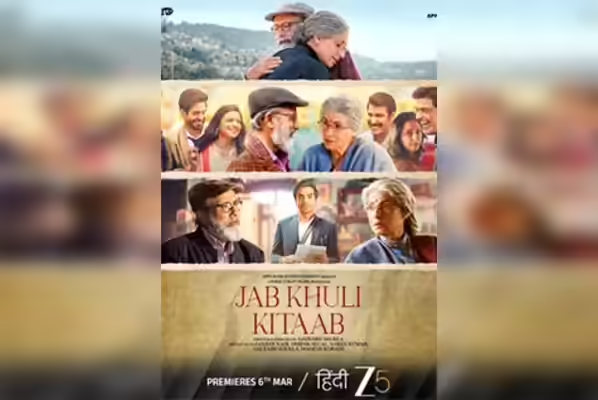
Jab Khuli Kitaab (2026) Movie Review: A Bittersweet Autopsy of a 50-Year Marriage
In an era of high-octane thrillers and loud cinematic spectacles, Saurabh Shukla’s Jab Khuli Kitaab (2026) emerges as a quiet, contemplative breath of fresh air. Adapted from Shukla’s own acclaimed stage play, the film explores the fragile ecosystem of a long-term marriage when it is suddenly struck by a bolt of long-buried truth. Starring the legendary Pankaj Kapur and the luminous Dimple Kapadia, this ZEE5 original serves as a poignant reminder that romance—and its messy repercussions—does not belong solely to the young.
Movie Information Table
| Category | Details |
| Title | Jab Khuli Kitaab |
| Release Date | March 6, 2026 |
| Director | Saurabh Shukla |
| Cast | Pankaj Kapur, Dimple Kapadia, Aparshakti Khurana, Samir Soni, Manasi Parekh |
| Genre | Romantic Comedy-Drama / Slice-of-Life |
| Runtime | 115 Minutes |
| Streaming Platform | ZEE5 |
| Language | Hindi |
Plot Synopsis: When the Coma Ends, the Chaos Begins
The story is set against the serene, mist-covered backdrop of Ranikhet, Uttarakhand. It begins with a display of unwavering devotion: 74-year-old Gopal Chandra Nautiyal (Pankaj Kapur) has spent the last two years caring for his wife, Anusuya (Dimple Kapadia), who lies in a persistent comatose state. Gopal’s daily routine is a ritual of love—he talks to her, updates her on the household mundanities, and refuses to let their children “pull the plug.”
When the family gathers, expecting to bid her a final goodbye, the miraculous happens: Anusuya wakes up. However, the joy of her resurrection is fleeting. Fearing she was on her deathbed and wanting to “cleanse her soul,” Anusuya confesses a secret hidden for over five decades. She reveals a brief extra-marital liaison with a former colleague during the fourth month of their marriage—a revelation that carries the added weight of a paternity bombshell regarding their eldest son, Param (Samir Soni).
Stunned and feeling his entire life has been a fabrication, the rigid and traditional Gopal decides he can no longer remain her husband. What follows is a tragicomic legal battle as Gopal hires a desperate, young local lawyer, RK Negi (Aparshakti Khurana), to file for divorce. The film navigates the absurdity of a 70-year-old couple seeking separation while their adult children struggle to keep the family unit from imploding under the weight of the “open book.”
Detailed Critique: Analyzing the Anatomy of Betrayal
Direction and Screenplay
Saurabh Shukla, a veteran of both stage and screen, brings a theatrical intimacy to the direction. The film feels deeply personal, often relying on long, dialogue-heavy takes that allow the veteran leads to inhabit their characters fully. While the transition from stage to screen results in some pacing lulls—particularly in the second act—Shukla succeeds in balancing the gravity of infidelity with the inherent humor of its circumstances. The screenplay cleverly uses the lawyer, Negi, as a surrogate for the audience, mirroring our bewilderment at a man who wants to divorce a woman he spent fifty years loving.
Performances: A Masterclass in Acting
Pankaj Kapur is, predictably, a tour de force. He portrays Gopal not as a villain, but as a man whose fundamental identity is shattered. His transition from a tender caregiver to a crotchety, wounded husband is seamless. He handles the comedic beats—specifically his bickering with Negi—with a dry wit that never undermines the character’s pain.
Dimple Kapadia provides the perfect counterweight. Even in the early scenes where she is silent and stationary, her presence is felt. Once “awake,” she portrays Anusuya with a mixture of immense regret and a strange, newfound freedom. She avoids the “weeping wife” trope, instead presenting a woman who is ready to face the consequences of a mistake she carried for a lifetime.
Aparshakti Khurana deserves special mention for injecting energy into the film. As the bumbling yet earnest lawyer, he provides much of the film’s levity. His chemistry with Kapur, evolving from a professional relationship into an unlikely drinking-buddy bond, is one of the film’s highlights.
Visuals and Sound
The cinematography by Adri Thakur captures the quiet beauty of Uttarakhand without making it look like a tourism brochure. The muted colors and misty landscapes reflect the melancholic, autumn years of the protagonists’ lives. The music, while functional, occasionally leans too heavily into “sentimental” territory, though the title track provides a hauntingly beautiful backdrop to the film’s climax.
Strengths and Weaknesses
Strengths
-
Veteran Chemistry: The pairing of Kapur and Kapadia is a rare treat, offering a nuanced look at senior-citizen companionship.
-
Thematic Depth: The film bravely tackles the “Baghban” complex—the idea that parents must remain perfect icons for their children—and deconstructs it.
-
Humor in Tragedy: The absurdity of the divorce proceedings provides genuine laughs without mocking the characters’ emotions.
-
Setting: The choice of Ranikhet adds a layer of isolation and intimacy that complements the narrative.
Weaknesses
-
Theatrical Hangover: Some scenes feel static and “stagey,” revealing the film’s origins as a play.
-
Subplot Overload: The issues regarding the children—specifically the son-in-law’s financial crisis—feel like unnecessary padding that distracts from the central couple.
-
Rushed Conclusion: The resolution of the paternity issue and the final emotional payoff feel slightly hurried compared to the slow-burn buildup of the first half.
Final Verdict: A Mature, Moving Dramedy
Jab Khuli Kitaab is not a film for those seeking rapid-fire plot twists or high-stakes action. It is a “slice-of-life” drama that demands patience. It asks uncomfortable questions: Can fifty years of devotion be undone by one night of weakness? Is truth always the best policy?
While it occasionally stumbles over its own theatrical roots, the power of the central performances makes it a compelling watch. It is a heart-tugging, honest, and ultimately hopeful exploration of the fact that love, even when wounded, has a remarkable capacity for resilience.
Rating: 3.5/5 Stars