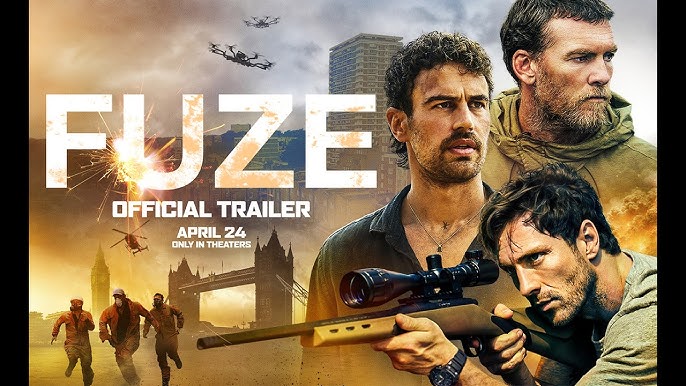
Precision Under Pressure: A Deep Dive into David Mackenzie’s ‘Fuze’ (2025)
The heist genre is often defined by its clockwork precision, but in David Mackenzie’s latest thriller, Fuze (2025), the clock isn’t just a metaphor—it’s a five-hundred-pound relic of the Blitz. Reuniting with his Outlaw King lead Aaron Taylor-Johnson, Mackenzie pivots from the elegiac neo-Western tones of Hell or High Water to a propulsive, London-set “ticking clock” thriller that leverages urban chaos for cinematic tension.
Fuze premiered at the 2025 Toronto International Film Festival (TIFF) before its wide theatrical rollout in 2026. It positions itself as a gritty, blue-collar alternative to the glossy Ocean’s franchise, trading neon lights for the damp, claustrophobic basements of Paddington.
Movie Overview: ‘Fuze’ (2025)
| Category | Details |
| Director | David Mackenzie |
| Writer | Ben Hopkins |
| Lead Cast | Aaron Taylor-Johnson, Theo James, Gugu Mbatha-Raw, Sam Worthington |
| Genre | Crime, Thriller, Heist |
| Runtime | 96 Minutes |
| Release Date | Sept 5, 2025 (TIFF); April 3, 2026 (UK); April 24, 2026 (US) |
| Cinematographer | Giles Nuttgens |
Plot Synopsis: The Perfect Distraction
The narrative of Fuze is built on a “can’t-miss” high-concept premise. During a routine excavation at a construction site in central London, workers unearth a massive, unexploded World War II ordnance. The discovery triggers an immediate “Operation Hydrant”: a massive security cordon, a blackout of the Paddington area, and the forced evacuation of thousands of residents.
While the Metropolitan Police, led by Chief Superintendent Zuzana Greenfield (Gugu Mbatha-Raw), struggle with the logistics of the exodus, an elite Army EOD (Explosive Ordnance Disposal) team arrives. At the helm is Major Will Tranter (Aaron Taylor-Johnson), a man whose steady hands mask a history of battlefield trauma.
However, the evacuation creates a “dead zone”—a pocket of the city devoid of witnesses and police patrols. This is exactly what Karalis (Theo James) has been waiting for. Leading a team of seasoned thieves, including the taciturn muscle known as X (Sam Worthington), Karalis uses the bomb threat as a tactical smokescreen. While Tranter drills into the fuse of a potential city-leveling explosive, Karalis and his crew are drilling into the vault of a high-security bank on Edgware Road.
As the two operations run parallel, the film reveals that the intersection of these men isn’t accidental. Through a series of reveals involving their shared military past in Afghanistan, the line between “hero” and “criminal” thins, leading to a climax where the bomb’s detonation becomes a commodity to be traded rather than a catastrophe to be avoided.
Detailed Critique: Momentum over Morality
Direction and Visual Style
David Mackenzie has always excelled at capturing the “weight” of a location. In Fuze, he treats London not as a postcard, but as a labyrinth of gray concrete and subterranean shadows. Working again with cinematographer Giles Nuttgens, Mackenzie utilizes a desaturated palette that mirrors the cold, industrial nature of the heist. The use of handheld cameras during the vault-drilling sequences creates a visceral, tactile experience that contrasts with the static, high-stakes tension of the bomb-disposal scenes.
Performances
Aaron Taylor-Johnson continues to solidify his reputation as one of the most physical actors of his generation. As Will Tranter, he delivers a performance defined by internalised stress; you can almost feel the sweat bead on his brow through the screen.
Theo James, fresh off the success of The Gentlemen, provides the perfect foil. His Karalis is charismatic yet volatile, a man who views crime as a logical extension of his military training. Sam Worthington offers a grounded, albeit underutilized, presence as the heist’s enforcer, while Gugu Mbatha-Raw provides the necessary procedural weight to the film’s exterior world, though the screenplay occasionally sidelines her character in favor of the central male conflict.
Screenplay and Themes
Ben Hopkins’ script is lean, perhaps to a fault. At 96 minutes, Fuze is a “no-fat” thriller that prioritizes pacing. The dialogue is sharp and professional, avoiding the flowery monologues often found in crime dramas. Subtextually, the film touches on the disenfranchisement of veterans and the way institutional neglect can turn specialized skills into dangerous liabilities. However, those seeking the deep sociopolitical commentary of Hell or High Water may find Fuze more focused on the “how” of the crime than the “why.“
Strengths and Weaknesses
Strengths
-
High-Stakes Pacing: The cross-cutting between the bank vault and the bomb disposal is masterfully edited by Matt Mayer, maintaining a relentless tempo.
-
Tactical Authenticity: The film leans into the technicalities of both safe-cracking and EOD work, making the tension feel earned rather than manufactured.
-
Atmospheric Score: Tony Doogan’s electronic score provides a thrumming, industrial heartbeat that perfectly complements the urban setting.
Weaknesses
-
Character Depth: While the performances are strong, the characters often feel like “types” (the Stoic Soldier, the Smooth Criminal) rather than fully fleshed-out individuals.
-
Predictable Twists: The third-act reversals regarding the characters’ shared history may feel familiar to seasoned fans of the genre.
Final Verdict
Fuze is a high-octane, expertly crafted genre exercise that proves David Mackenzie remains a master of the “pressure cooker” narrative. While it lacks the emotional resonance of some of his previous works, it succeeds as a visceral, edge-of-your-seat thriller that makes 96 minutes feel like a heartbeat. It is a must-watch for fans of Michael Mann’s Heat or the gritty British crime cinema of the early 2000s.