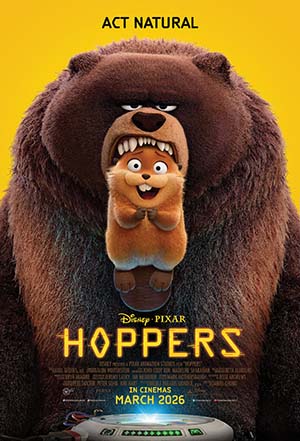
Hoppers (2026) Movie Review: Pixar Finds Its Wild, Weird Edge Again
Pixar Animation Studios has long been the gold standard for blending high-concept premises with deep emotional resonance. With its 30th feature film, Hoppers, directed by Daniel Chong (We Bare Bears), the studio ventures into a territory that is as technologically ambitious as it is narratively “unhinged.” Released on March 6, 2026, Hoppers is a sci-fi adventure comedy that tackles the environmental crisis not with a lecture, but with a chaotic, beaver-led uprising.
In an era where animation often leans on the safety of sequels, Hoppers stands out as a fiercely original work. It manages to feel like a “return to form” while simultaneously breaking the Pixar mold with a darker, more absurdist sense of humor.
Film Fact Sheet: Hoppers (2026)
| Category | Details |
| Director | Daniel Chong |
| Screenwriter | Jesse Andrews |
| Release Date | March 6, 2026 |
| Voice Cast | Piper Curda, Bobby Moynihan, Jon Hamm, Kathy Najimy, Meryl Streep, Dave Franco |
| Runtime | 105 Minutes |
| Genre | Animation / Sci-Fi / Comedy |
| Rating | PG |
Full Plot Synopsis: A Mind-Bending Leap into Nature
The story follows Mabel Tanaka (voiced by Piper Curda), a fiercely dedicated 19-year-old environmental activist living in the city of Beaverton. Mabel’s passion for the natural world is rooted in her childhood spent at a local forest glade with her late grandmother (Karen Huie). However, her sanctuary is under threat: the charismatic yet unscrupulous Mayor Jerry Generazzo (Jon Hamm) plans to bulldoze the glade to build a massive “Beaverton Beltway.”
Jerry’s justification is simple: the animals have all left, so there is no habitat left to protect. Desperate to prove him wrong, Mabel discovers a secret project led by her biology professor, Dr. Sam (Kathy Najimy). The “Hoppers” technology allows a human to “hop” their consciousness into a lifelike robotic animal.
Against Dr. Sam’s warnings, Mabel transfers her mind into a robotic beaver and escapes into the wild. She soon finds the displaced animals hiding in a “Superlodge” led by King George (Bobby Moynihan), a benevolent but weary beaver monarch. As “Mabel-Beaver,” she must navigate the complex “Pond Rules”—where animals coexist under a tenuous truce—while trying to convince the Animal Council to return to the glade.
The stakes escalate when the Animal Council, including the formidable Insect Queen (Meryl Streep) and her ambitious son Titus (Dave Franco), becomes involved. What begins as a mission to save a park turns into a full-blown species-swapping revolution, as Mabel discovers that being an “animal” requires more than just wearing a robotic skin; it requires understanding the delicate balance of trust and survival.
Detailed Critique: Where “Avatar” Meets “Looney Tunes”
Direction and Screenplay
Daniel Chong brings the same whimsical, character-driven energy found in We Bare Bears to a much larger canvas. The screenplay by Jesse Andrews (Luca) is sharp and surprisingly biting. The film frequently pokes fun at its own premise—Mabel explicitly compares the tech to Avatar, only to be told it’s “nothing like Avatar“—yet it commits fully to the absurdity of animal politics.
Voice Performances
The cast is arguably one of Pixar’s strongest in years. Piper Curda provides a grounded, rebellious anchor for the film, but Bobby Moynihan is the undisputed heart of the movie as King George. Jon Hamm delivers a hilarious performance as the glad-handing Mayor Jerry, imbuing the villain with just enough charm to make his corporate greed feel eerily realistic.
However, the third act is stolen by Dave Franco as Titus. Transitioning from a caterpillar to a butterfly, Titus becomes a surprisingly menacing antagonist, pushing the film into a “Terminator-esque” territory that provides a refreshing edge to the typical Pixar climax. Meryl Streep’s brief but regal turn as the Insect Queen adds a layer of gravitas to the otherwise zany proceedings.
Visuals and Sound
Visually, Hoppers is a masterclass in perspective. The animation shifts style depending on who is looking. From a human’s POV, the animals look like realistic, slightly beady-eyed creatures. From Mabel’s perspective as a beaver, the world explodes with color and expressive detail. The “Superlodge” is a marvel of environmental design—a sprawling, organic fortress of sticks and mud that feels lived-in and ancient. The score by Mark Mothersbaugh complements this with a quirky, synth-driven rhythm that underscores the film’s “weird science” roots.
Strengths and Weaknesses
Strengths
-
Originality: A refreshing break from sequels that takes genuine risks with its tone.
-
Humor: Successfully balances slapstick comedy for kids with sharp, satirical wit for adults.
-
Visual Innovation: The “perspective-shift” animation is a creative high point for the studio.
-
The Villain: Dave Franco’s Titus is one of the most memorable and genuinely threatening Pixar villains in a decade.
Weaknesses
-
Pacing: The middle act, involving the various animal “Kings and Queens,” occasionally feels a bit cluttered with too many characters.
-
Complexity: The “consciousness-hopping” mechanics are occasionally hand-waved, which might confuse the youngest viewers.
Final Verdict
Hoppers is Pixar at its most daring. It is a film that isn’t afraid to be weird, chaotic, or even a little bit scary. By focusing on a “keystone species” like the beaver, Daniel Chong has created an environmental fable that feels urgent for 2026 without ever sacrificing the joy of a good chase sequence. It is a poignant, hilarious, and visually stunning reminder that we are all part of a larger ecosystem—whether we’re in our own skin or a robotic beaver’s.
Final Score: 9/10